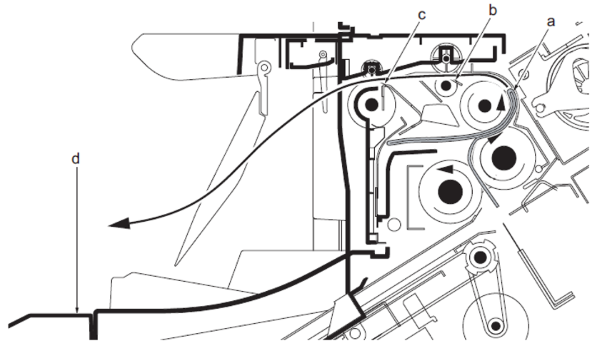
Floor Finisher
Overview
The floor finisher consists of the following four elements.
- Paper transport and branch mechanism
- Processing mechanism
- Waiting drum mechanism
- Binding and folding mechanism
Paper transport and branch mechanism
The Paper transport and branch mechanism that the paper transported from the main body into the floor finisher and transports the paper to the paper path ahead.
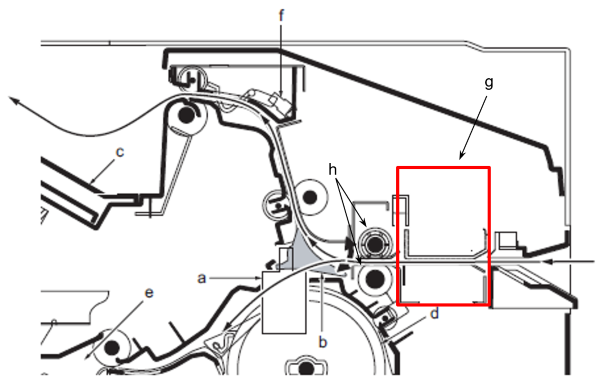
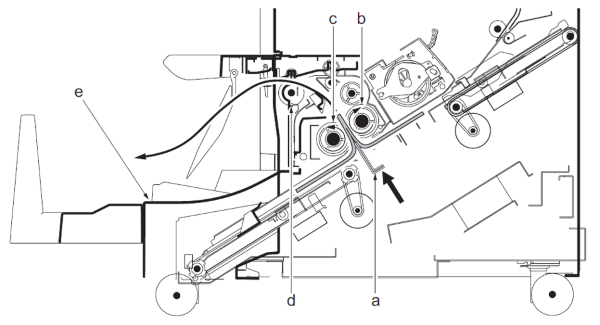
FIN output tray switching guide (b) is actuated by FIN output tray switching solenoid(a) to switch the transport path of the paper transported to the branching mechanism, eject it to the finisher output tray (c) or eject it to the waiting drum (d), processing mechanism (e). Also, FIN Output Tray Pre-Eject Sensor (f) detects a paper jam when ejecting the finisher output tray (c).
As an option, a punch unit can be installed at (g). The loaded paper is skewed (improved skew) by two rollers (h), and punched one by one.
Processing Unit
The processing mechanism for carrying out paper transport and branch mechanism such as discharging a bundle of sheets conveyed from the sheet loading/branching section and discharging staples.
Bundle ejection operation (1st sheet)
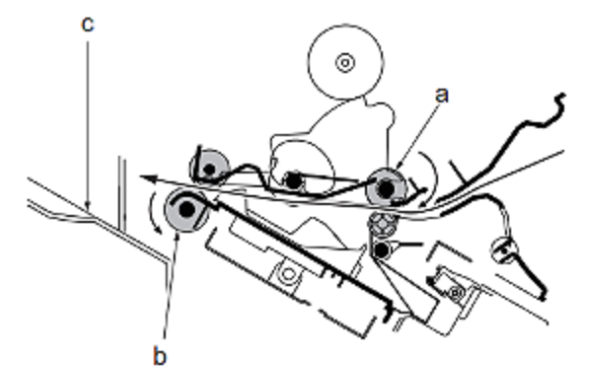
The Intermediate Roller (a) rotates to feed the paper to the Processing part. Also, it is sent to the finisher output tray (c) by the finisher output tray eject roller (b).
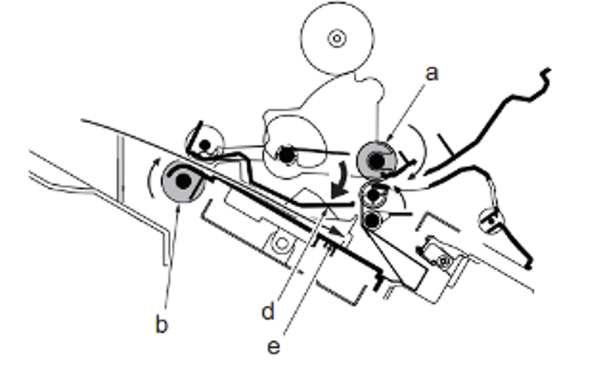
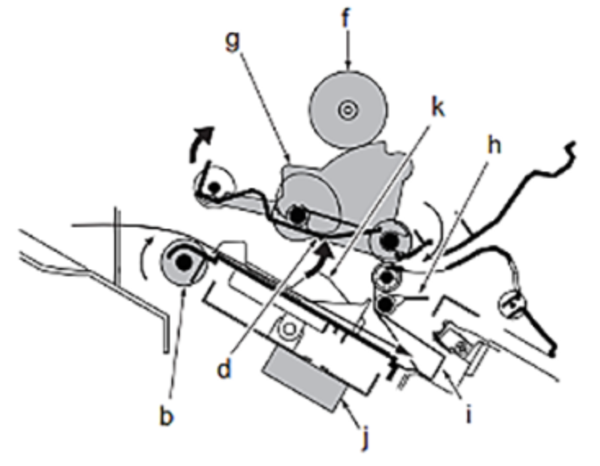
When the trailing edge of the paper passes the Intermediate Roller (a), the Paper Feed guide (d) moves downward. After that, the Finisher output tray Lower Document EjectionRoller (b) rotates in the reverse direction to feeds the paper to the Document Alignment Tray (e).
The Paper Feed guide (d) moves upward, and then the Finisher Ejection Unlock Motor (f) raises the Document Bundle Ejection Unit (g). The sheet is sent to the alignment tray hit (i) by the rotation of the finisher output tray discharge roller (b) and alignment paddle (h). The Finisher Document Alignment Motor, 1,2 (j) operates the Document Alignment Guide (k) to align the documents.
Bundle ejection operation (2nd sheet and later)
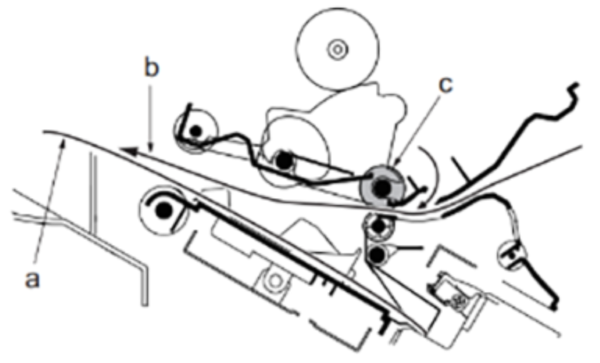
The 2nd sheet (b) is feeded to the Processing part by the rotations of the Finisher Document Insertion Roller and the Finisher Intermediate Roller (c) in the same way as the 1st sheet.
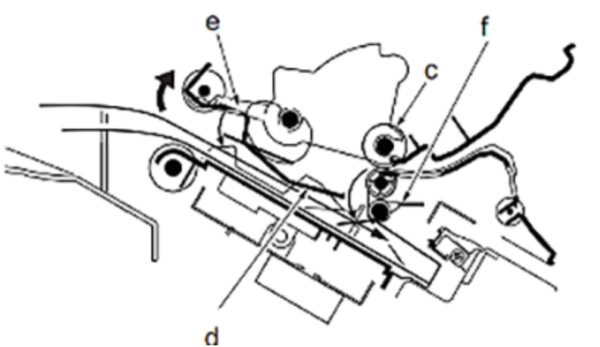
When the trailing edge of the paper passes the Intermediate Roller (c), the Paper Feed guide (d) moves downward. The paper is feeded to the Document Alignment Tray (g) by the rotations of the Paddle (e) and the Document Alignment Paddle (f). The paper is aligned in the same way as the 1st sheet.
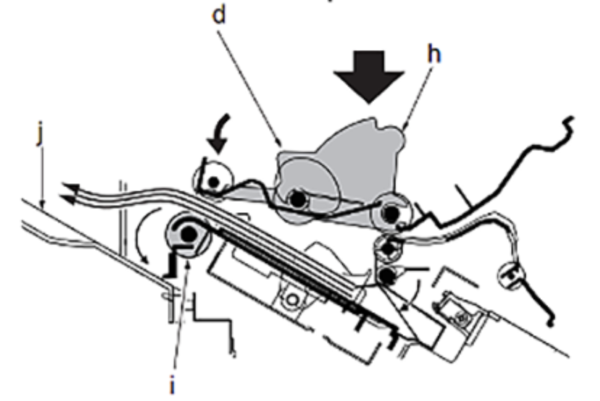
When the alignment of the final paper finishes, the Bundle Eject Unit (h) descends, and the finisher tray ejection roller (i) rotates to discharge the sheet bundle finisher output tray (j).
Staple Stack Operation
- After completion of the alignment process for the last sheet of the bundle, the stapling unit is moved to the stapling position by driving the slide motor.
- Performs 1-point/2-point stapling according to the setting.
When the stapling process is completed, the Bundle Eject Unit (h) descends, and the finisher tray ejection roller (i) rotates to discharge the sheet bundle finisher output tray (j).
Waiting drum mechanism
When outputting paper of a specific size (B5 SEF/A4 SEF/Letter SEF) to the tray below the finisher, the paper is transported using the waiting drum in order to prevent a drop in throughput.
In order to minimize the time between sets (vacant time between sets), while the first set is undergoing intermediate processing in the processing mechanism, the 1st and 2nd sheets of the 2nd set are moved to the waiting drum mechanism. Convey the paper and put it in the standby state. After completing the discharge process for the first set, the stack of sheets is overlapped with the third sheet and transported from the waiting drum to the processing mechanism. The fourth and subsequent sheets are conveyed one by one to the processing mechanism.
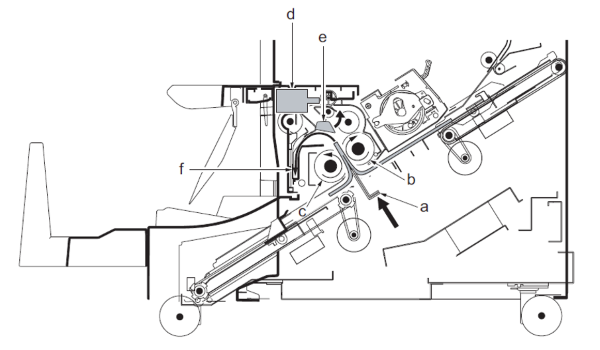
A FIN waiting drum branching guide (b) is actuated by the FIN waiting drum branching solenoid (a) to transport the first sheet of paper to the waiting drum (c).
The second sheet conveyed in the same manner is also carried into the waiting drum (c), and makes one revolution of the evacuation drum while being overlapped with the first sheet.
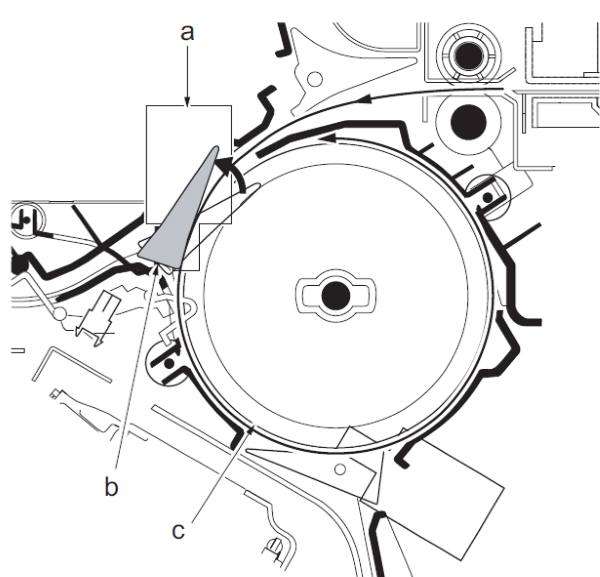
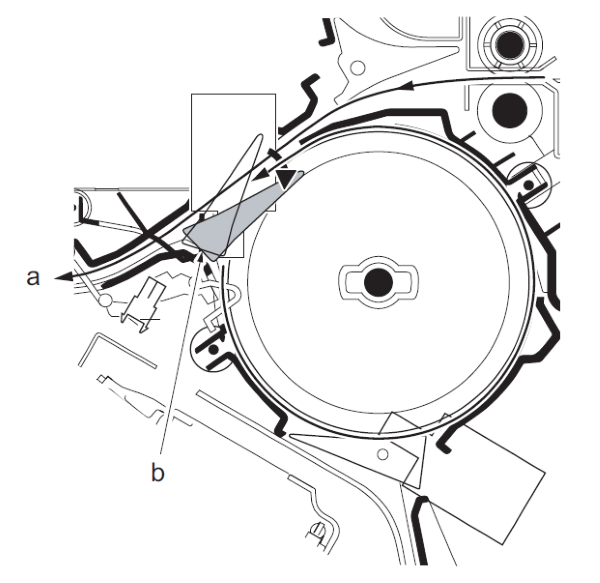
The FIN waiting drum branching solenoid operates the FIN waiting drum branching guide (b) to switch the transport path to the processing mechanism.
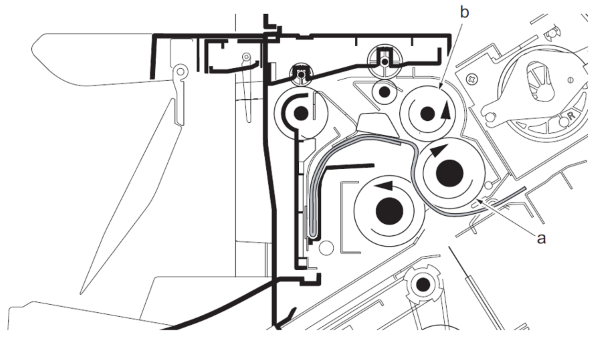
The 3rd sheet of the next group is not carried into the waiting drum, it is transported to the processing section (a) together with the 1st and 2nd sheets.
Binding and folding mechanism
By installing the optional saddle unit, saddle stitching and center folding functions can be used. This product also supports tri-folding.
Saddle stitching/half-folding operation
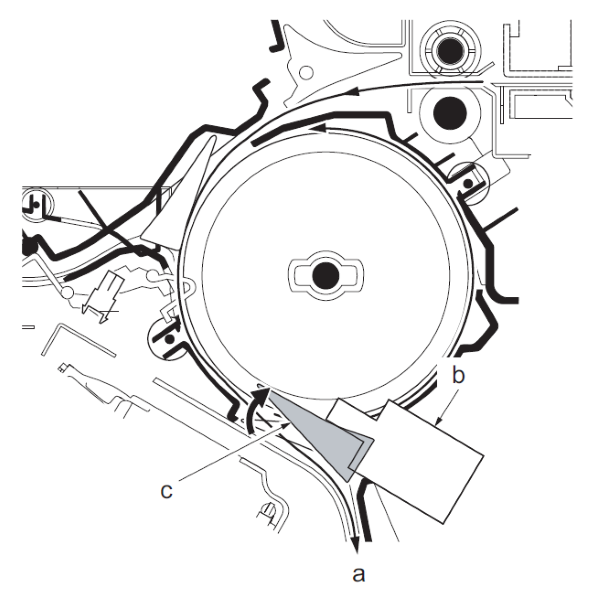
The FIN saddle stitching branch solenoid (b) operates the FIN saddle stitching branch guide (c) to switch the transport path to the Saddle stitch path (a).
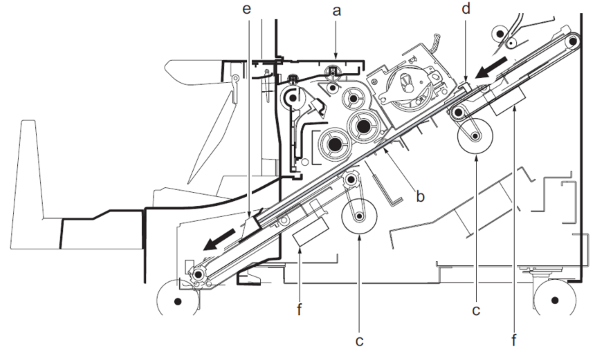
- The sheets (b) stacked in the folding unit (a) are moved to the half-fold position by using the saddle stitch stack movement lowering plate (d) and the saddle stitch stack movement lifting plate (e) which are driven by the saddle stitch stack up/down drive motor (c).
- Paper width aligned by driving the saddle stitch alignment motors left & right (f). When performing saddle stitching, stapling is performed at this moment.
- A saddle-stitch folding blade drive motor drives the saddle-stitch folding blade (a) to push up the center of the paper. As a result, the paper is sandwiched between right saddle stitch folding roller (b) and the left saddle stitch folding roller (c), and is saddle-folded.
- The folded paper is delivered to the saddle stitch tray (e) by the right saddle stitch folding roller (b), the left saddle stitch folding roller (c), and the saddle stitch output roller (d).
Tri Folding:
The stacking sheets are moved to the tri-fold position by using the saddle stitch stack movement lowering plate (d) and the saddle stitch stack movement lifting plate (e) which are driven by the saddle stitch stack up/down drive motor (c).
After the paper has been aligned, the saddle stitch folding blade (a) pushes the paper up. As a result, the paper is sandwiched between the right (b)/left (c) saddle stitch folding rollers, and the first folding process is performed.
A saddle stitching tri-folding path branching solenoid (d) operates a saddle stitching tri-folding path branching guide (e) to switch the conveying path to the standby area (f).
When the paper does not advance in the standby area anymore, the slack in the space behind will get pinched in the right saddle stitch folding roller (a) and the upper saddle stitch folding roller (b), and the paper will be folded inward.
The paper folded in three (a) is delivered to the saddle stitching tray (d) by the saddle stitching transport roller (b) and the saddle stitching output roller (c).