Print head
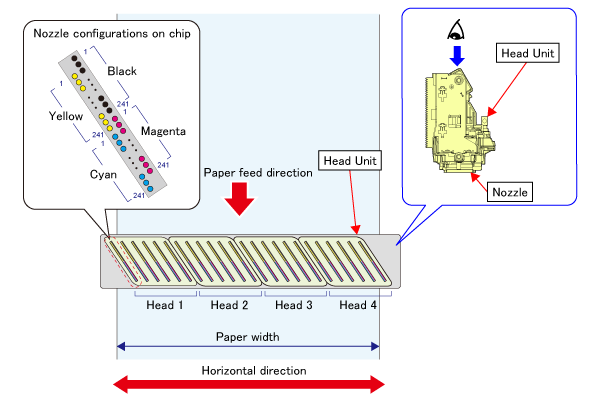
The print head of this product uses a μ-TFP line head unit. For product miniaturization, the four print heads are arranged in a straight line to constitute the head unit.
In addition, the diagonal arrangements of high density nozzle arrays provide the resolution of 600 dpi (horizontal direction), and the printing with the resolution of up to 600 x 2400 dpi (horizontal direction x paper feed direction) depending on the paper feed speed.
These features contribute to higher image quality and faster printing.
Print head appearance
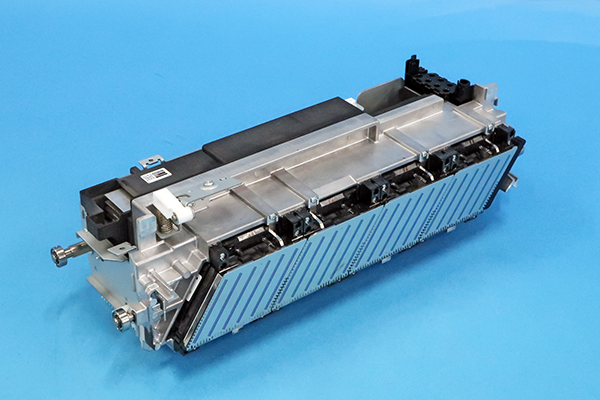
- Ink ejection surface
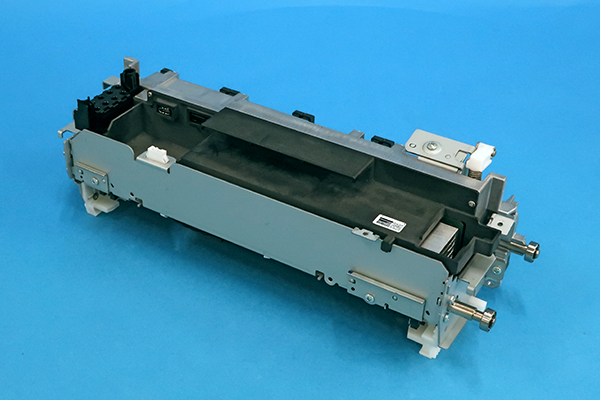
- Unit upper face
Print head unit configuration and specifications
Configuration (perspective view from above)
Specifications
| Items | Specifications |
|---|---|
| Print Head Unit type | μTFP line |
| Total number of heads | 4 Head |
| Total number of chips | 24 chips (6 chips x 4 heads) |
| Total number of Nozzle | 23,136 nozzles (964 nozzles x 6 chips x 4 heads) |
| Number of nozzles per chip | 964 nozzles (482 nozzles x 2 columns) * Each column is divided into two sections, with the first column assigned to yellow and cyan, and the second column assigned to black and magenta. |
Chip configuration and printing image
The diagonally arranged chips, together with neighboring chips, fire droplets of ink each about 10mm wide to create an image.
To avoid conspicuous joints between chips, 2 of the 241 nozzles overlap with nozzles of the same color on adjacent chips. The chip configurations and the printing image are shown below.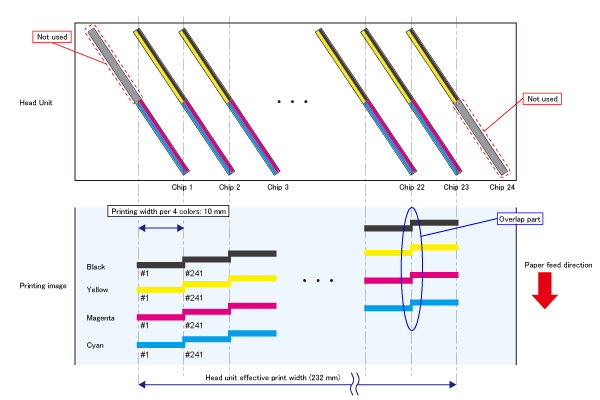
Relationship between Printable Area and Head unit effective print width
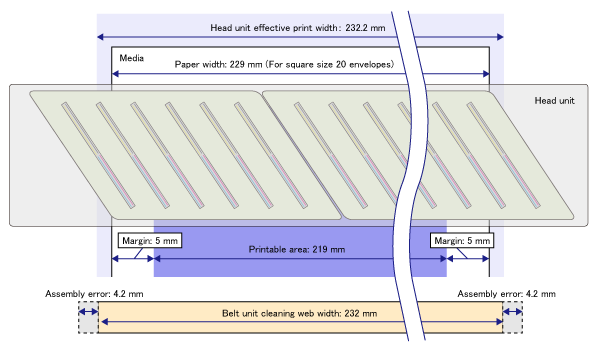
The effective print width of the head unit, consisting of four heads, is 232.2 mm. On the other hand, the printable area is 219 mm, resulting in a margin of 13.2 mm (6.6 mm on each side).
This margin is used for Side Registration Adjustment Width via software, and is comparatively wide. However, the Belt Unit Cleaning Web has been narrowed to make the product more compact, and when referencing the installation range, the width adjustment for the Side Registration Adjustment Width via software is essentially small.
Therefore, if there is a large paper position deviation due to hardware factors, narrow Side Registration Adjustment via software may result in uneven left and right margins and print overflow from the paper.
Therefore, when performing Side Registration Adjustment with this product, it is necessary to perform hardware side register adjustment first to secure the software side register adjustment range.